
How LLMs, GEO, and AEO are Redefining Search, and How to Make Sure Your Business Doesn’t Get Left Behind
Introduction: The Web is Changing Right Under Our Feet
Imagine you run a fantastic local bakery, an amazing plumbing business, or a modern online store. For years, you have known exactly how people find you. They sit down at a computer or pull out a smartphone, open up a search engine like Google, and type in a few words like “best chocolate cake near me” or “emergency plumber.” Then, they scroll through a neat list of blue links, clicking on a few websites until they find what they need.
This system is called traditional Search Engine Optimization, or SEO for short. It is the art and science of setting up your website so that Google can read it easily and rank it at the top of that list of blue links. For over two decades, SEO has been the golden rule of digital marketing. If you ranked high on the first page, your business thrived.
But recently, a massive shift has occurred. People are starting to change how they look for answers online. Instead of scrolling through pages of links, they are turning to smart Artificial Intelligence (AI) helpers like ChatGPT, Google Gemini, and Microsoft Copilot. They do not just want a list of websites anymore. They want a fast, direct, and complete answer to their questions right away.
If someone asks an AI tool, “What is the best bakery in town for a nut-free birthday cake, and are they open on Sunday morning?” the AI will not give them ten links. It will give them one clear, spoken or written answer. It will name a specific bakery, explain why it fits the request, and list the hours. If that bakery isn’t your business, you just lost a customer without them ever seeing your website.
example:
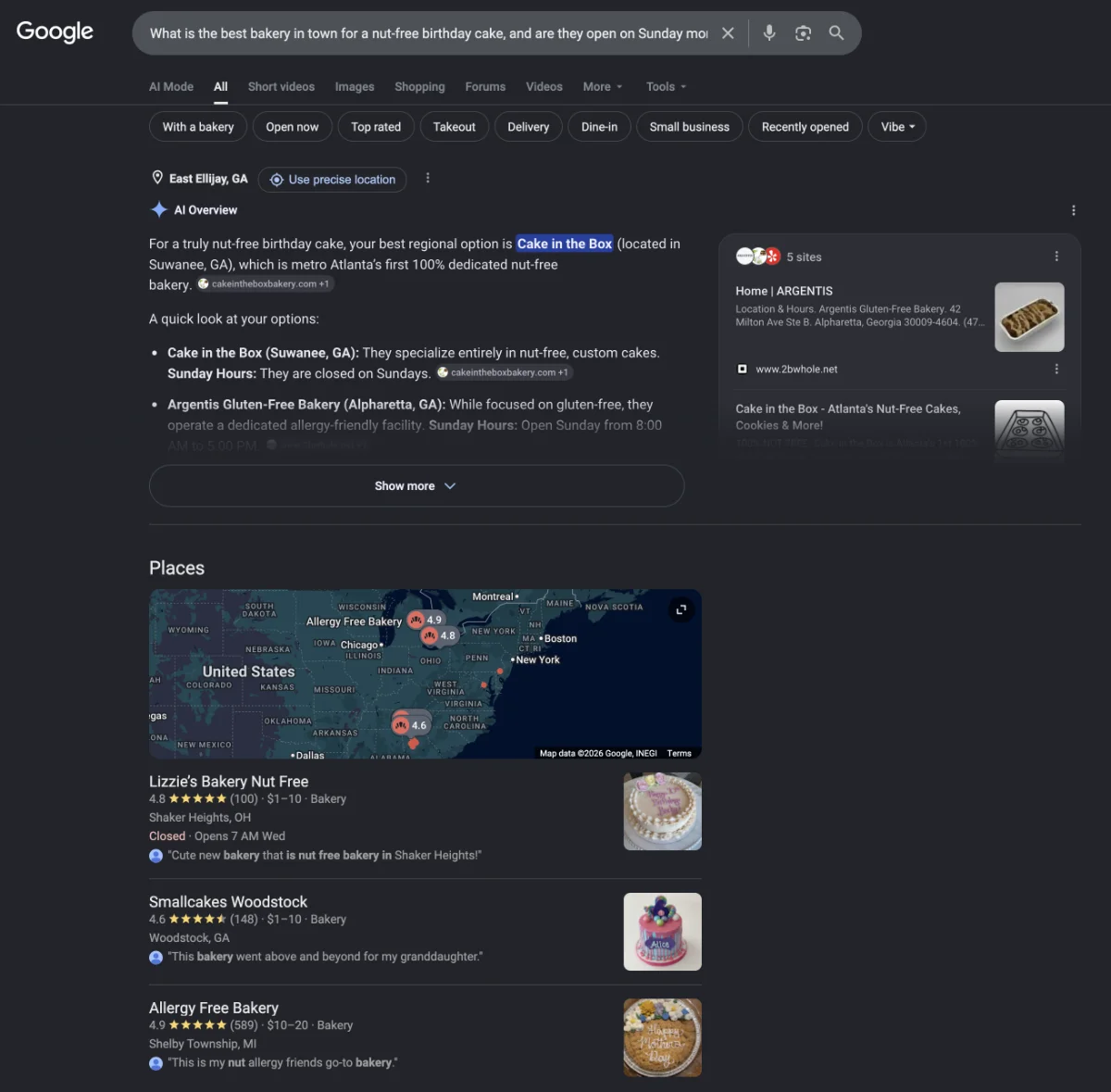
This means we are entering a brand-new era. To stay visible, your website can no longer just be built for regular humans and old-school search systems. It must be optimized for AI. In this guide, we will break down exactly what that means, explain the new rules of the road, and show you how a blend of old and new tactics will keep your business growing strong.
The Digital Tour Guide: An Analogy
Imagine your website is a real, physical museum filled with wonderful information and objects. In the old days of the internet, search engines were like a basic road map. They told people, “Drive down this highway, and you will find the museum on the left.” As long as you had a clear sign on the highway, people could drive over and walk through your doors to explore.
Today, AI tools act like a highly personal, hyper-smart Tour Guide. The traveler does not want to look at a map or drive all over town. Instead, they sit in a comfortable chair and ask the Tour Guide, “Tell me about the most interesting artifact in town.” The Tour Guide runs across town, enters all the museums, reads everything inside them instantly, speeds back, and summarizes the best parts for the traveler.
If your museum has its doors locked, keeps its lights turned off, or writes its signs in a messy, confusing handwriting, the Tour Guide will simply ignore you. The guide will go next door to a museum that is brightly lit, perfectly organized, and hands over clear, simple summaries. Optimizing your website for AI is like making your website the absolute favorite stop for that digital Tour Guide.
Meet the New Drivers: What are LLMs?
To understand how to prepare your website, you first need to understand the engines powering this change. These engines are called Large Language Models, or LLMs.
An LLM is a type of AI computer program that has read billions of pages of text from books, articles, and websites. Because it has read so much, it understands human language incredibly well. It does not just look for matching keywords like an old computer program. It understands context, feelings, and the deeper meaning behind questions.
When an LLM answers a question, it uses its massive memory to piece together sentences word by word, predicting what makes the most sense. It acts like an extremely well-read person who can write a custom essay for you in two seconds flat.
However, LLMs do not know everything automatically. They learn from the data they are fed. If your business website is full of confusing sentences, broken links, or missing information, the LLM will fail to understand what you sell or how you help people. When it writes its answers for users, it will leave you completely out of the conversation. Therefore, we must learn to format our sites so these digital brains can digest our content effortlessly.
The New Rules of Search: GEO and AEO
Because search is changing, marketing experts have come up with new terms to describe how we optimize websites today. The two most important concepts you need to know are GEO and AEO. Let’s look at each one closely.
1. GEO: Generative Engine Optimization
Generative Engine Optimization is the evolution of traditional SEO. Generative engines are tools that do not just find information; they generate new responses combining multiple sources. Examples include Google’s Search Generative Experience (SGE)—which puts a big, AI-written box at the very top of your regular Google results—and tools like Perplexity AI.
GEO is all about making sure these AI boxes include your business when they build their answers. When a generative engine creates a response, it usually leaves small footnotes or source links pointing to where it found the facts. To win at GEO, your website content needs to be so accurate, authoritative, and clear that the AI chooses to use your site as its primary source and links back to you as proof.
2. AEO: Answer Engine Optimization
Answer Engine Optimization focuses heavily on a specific goal: providing the single, definitive answer to a direct question. Think about how people use smart speakers like Amazon Alexa or Apple Siri, or how they type quick questions into ChatGPT: “Can you freeze fresh spinach?” or “What is the weight limit for a standard drywall anchor?”
In these moments, users are not looking to browse. They want a quick, accurate answer. AEO is the practice of structuring your website’s text so that an AI engine can instantly pluck out the perfect answer. This usually involves using clear questions as headings and writing direct, factual answers right below them.
How Traditional SEO and AI Optimization Work Together
At this point, you might be wondering: “Does this mean traditional SEO is dead? Do I throw away everything I have already done?”
The answer is a loud, clear no! Traditional SEO is not dead at all. In fact, it forms the bedrock upon which all AI optimization is built. Think of traditional SEO as the strong foundation of a house, while AI optimization (GEO and AEO) represents the modern smart technology and beautiful styling you build on top of it. You cannot have a great smart home without a sturdy foundation.
Let’s look at how the traditional rules and the new AI rules work side-by-side to create the ultimate modern website strategy:
- Website Speed and Technical Health: Traditional SEO teaches us that a website must load incredibly fast and work well on mobile phones. Guess what? AI bots hate slow websites too. If an AI engine tries to read your site to find an answer for a user and your page takes too long to load, the bot will give up and move to your competitor’s site.
- Trust and Authority: Google has long emphasized a concept called E-E-A-T, which stands for Experience, Expertise, Authoritativeness, and Trustworthiness. AI models are trained to look for these exact same traits. They prefer quoting trusted experts over random, anonymous blogs. Traditional practices like earning good reviews and getting other trusted sites to link to you make AI models trust you more, too.
- Keywords vs. Intent: Traditional SEO used to focus heavily on repeating exact words over and over (like “cheap shoes”). Modern SEO and AI both focus on user intent—understanding the problem the user is trying to solve and providing a complete, helpful guide that solves it.
Actionable Steps: How to Make Your Website AI-Ready
Now that you know why this matters, let’s talk about real things you can do to tune up your website for the AI age. You do not need to be a computer scientist to understand these steps:
- Use Clear, Natural Language: AI models understand human conversation. Avoid using overly complicated business jargon or writing text that sounds like it was written by a robot just to trick an old search engine. Write like an expert talking to a friendly customer. Use straightforward sentences that directly address your customer’s problems.
- Create Robust FAQ Sections: Since AEO is all about answering direct questions, adding a Frequently Asked Questions (FAQ) page to your website is incredibly powerful. Write out the exact questions your customers ask in real life, format them as clear headings, and write a 2-to-3 sentence answer directly underneath. This makes it incredibly easy for an AI tool to copy and paste your answer while giving you credit.
- Include Real Data, Statistics, and Unique Insights: AI models love hard facts. If your website says, “We are a really good roofing company,” that doesn’t help an AI very much. But if your website says, “We have repaired over 1,200 roofs in the tri-county area using weather-resistant asphalt shingles that last up to 30 years,” the AI has real data to work with. It can confidently tell users exactly why your company is a strong choice.
- Organize Content with Proper Headings: Use clear formatting like Heading 2 (H2) and Heading 3 (H3) tags to break up your text. Think of headings like the chapters of a book. They tell the AI exactly what each section of your page is about, allowing it to skim your site and find relevant details in milliseconds.
Conclusion: Let Four Winds Marketing Prepare You for the Future
The digital world moves incredibly fast, and the rise of Artificial Intelligence is the biggest change we have seen in decades. It can feel overwhelming to think about updating your website to satisfy human customers, traditional search engines, and advanced AI models all at the same time. But you do not have to do it alone.
At Four Winds Marketing, we specialize in helping businesses navigate these exact changes. We know how to take your existing website and give it a complete, modern tune-up. We will make sure your site is fully optimized for LLMs, GEO, and AEO, while keeping your traditional SEO foundations rock-solid.
We will help you transform your website into the ultimate destination for digital tour guides, ensuring that when future customers ask AI for help, your business is the one that gets recommended. Contact Four Winds Marketing today, and let’s get your business completely ready for the future of the web!
The Longer You Wait to Convert Your Website for AI, The Longer It Will Take To Rank At All!
We convert websites to the format that AI loves!